
June 30, 2026
Mitsubishi Electric Corporation
Kyoto University
National Institute for Fusion Science, National Institutes of Natural Sciences (NIFS)
Research Results (Press Release)Advanced System for Simultaneous, Long-duration,
Multi-point Plasma Measurement Developed in Japan Plasma control diagnostics expected to advance the implementation of fusion energy
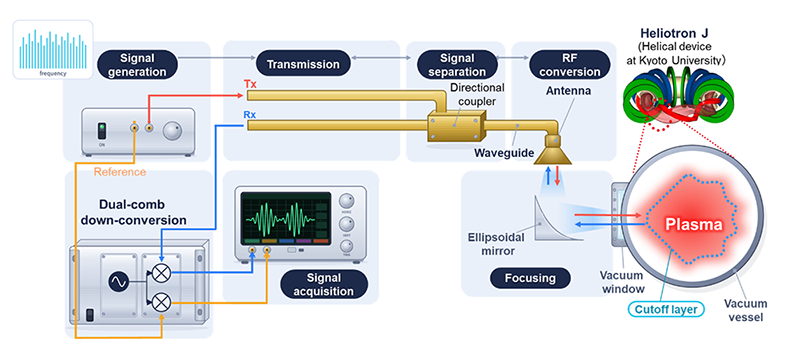
Mitsubishi Electric Corporation, Kyoto University’s Institute of Advanced Energy, and the National Institute for Fusion Science (NIFS) announced today that they have developed an advanced, world-class1 microwave plasma measurement system for fusion energy.2 The system is capable of simultaneously measuring plasma conditions at multiple points over extended periods. The joint team successfully demonstrated the system using the Heliotron J fusion experimental device at Kyoto University. The three collaborators aim to promote the development of plasma diagnostics technologies necessary for the practical implementation of fusion energy.
Fusion energy is highly anticipated as a next-generation, carbon-free energy source. Under its Fusion Energy Innovation Strategy3 and related initiatives, the Japanese government is supporting R&D and industry-academia-government collaboration targeting power generation demonstrations by the 2030s. To realize fusion energy, it is essential to establish reliable diagnostic technologies for the real-time monitoring of fusion plasma, which reaches temperatures exceeding 100 million degrees Celsius. Microwave measurement technology is a promising approach because it allows key components to be installed separately from the plasma, even inside a fusion reactor, where equipment is susceptible to damage from neutron irradiation. Since 2025, Mitsubishi Electric, Kyoto University and NIFS have been collaborating to advance microwave measurement technologies and their implementation in experimental systems.
The new system utilizes frequency comb4 microwaves, which use multiple frequency components at the same time to simultaneously acquire reflection signals from multiple measurement points within the plasma. Furthermore, by adopting a dual-comb down-conversion5 method in the receiver system to reduce the load on high-frequency signal processing, the team achieved continuous measurement throughout the entire discharge duration. As a result, the system achieved world-class performance capable of simultaneous measurements at up to 34 points6 over long durations, which were successfully demonstrated with the Heliotron J.
These research results were presented on June 29 at the EPS Plasma Physics Conference 2026, Europe’s largest international conference on plasma physics, held in the United Kingdom from June 29 to July 3.
Features
1) World-class simultaneous measurements at up to 34 points over long durations
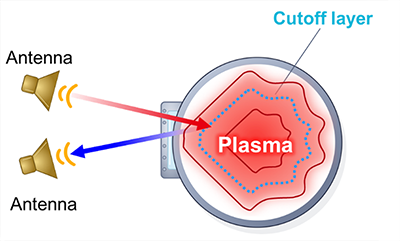
-When microwaves are injected into plasma, they are scattered and reflected at specific electron densities (cutoff density7) corresponding to their frequency. The reflected waves undergo frequency shifts due to the Doppler effect,8 which are determined by the rotational speed of the reflecting layer. Using frequency comb microwaves enables simultaneous multiple-point measurement of these frequency shifts.
-The system utilizes a frequency comb with 34 teeth (frequencies), enabling simultaneous measurement at up to 34 points.
-Integration of the dual-comb down-conversion method in the receiver system enables stable, long-duration measurements.
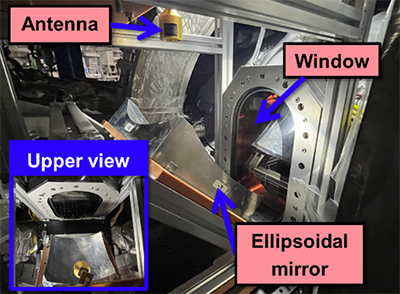
2) Integrated plasma diagnostic system successfully demonstrated with the Heliotron J
-A system integrating everything from the frequency comb microwave transmitter to transmit-receive optics was installed in the Heliotron J fusion plasma experimental device.
-Experimental results confirmed the successful long-duration measurement of frequency shifts at up to 34 points in response to changes in the plasma state.
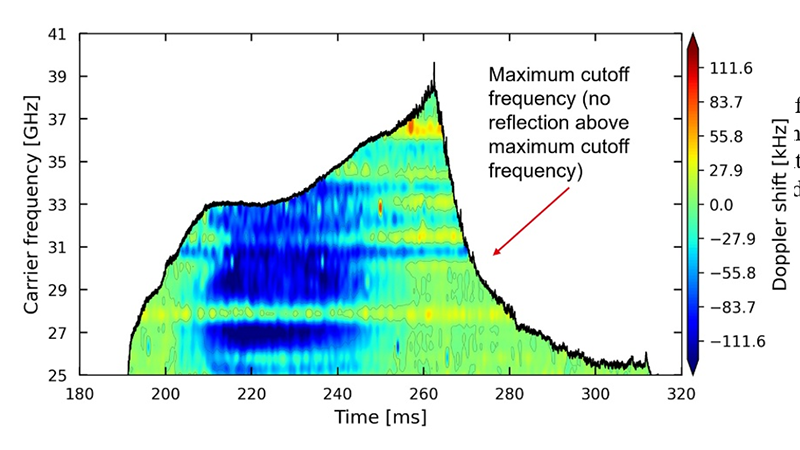
34 frequency components (y-axis) and their temporal changes (x-axis). Red and blue respectively indicate positive and negative frequency shifts relative to the incident frequency.
Roles in System Development
| Entity | Responsibilities |
|---|---|
| Mitsubishi Electric | Development of microwave transmit-receive systems and construction of measurement system for Heliotron J |
| Kyoto University | Generation of high-density plasma and analysis of plasma physical phenomena |
| NIFS | Development of dual-comb down-conversion method and analysis of plasma physical phenomena |
Future Development
Mitsubishi Electric, Kyoto University and NIFS will continue to advance plasma control technologies using frequency comb microwaves, aiming to construct even more detailed plasma measurement systems. They will also study the construction of systems with superior environmental resistance for use in commercial reactors, targeting power generation demonstrations in the 2030s.
Glossary
1According to research by Mitsubishi Electric, Kyoto University, and NIFS as of June 29, 2026.
2Energy released when light atomic nuclei fuse to form a different nucleus—the same form of energy that powers the sun.
3https://www8.cao.go.jp/cstp/fusion/index.html (Japanese website).
4Microwaves consisting of numerous frequency components arranged at equal intervals, resembling the teeth of a comb, incorporating multiple frequency components simultaneously.
5A method that combines two frequency comb signals with slightly different intervals to convert high-frequency signals into easier-to-measure low-frequency signals, enabling the simultaneous acquisition of numerous frequency components.
6The number of measurement points depends on the state of the plasma's electron density and varies according to discharge conditions.
7The electron density at the boundary where microwaves can no longer propagate deeper into the plasma and are reflected. Since this density varies with the microwave frequency, the internal structure of the plasma can be analyzed by varying the frequency.
8A phenomenon in which the frequency (such as the pitch of a sound) of waves is observed to change when the source of the sound or radio waves is in motion.
Inquiries
National Institute for Fusion Science (NIFS)
